Short controller-based tests of attention, processing speed and executive functions (CPT, Stroop, Corsi, finger tapping, serial calculation) run during a session, with result tables, z-scores and report scores.
Cognitive tests run during a recording, note or training session and measure attention, processing speed and executive functions with a game controller: the Continuous Performance Test (CPT, square and circle), the Stroop colour-word test, Corsi block tapping, finger tapping and serial calculation. They are listed on the left-hand side of the session; each opens a client window for the second screen and a 20-second test run lets the client try the controls before the real run.
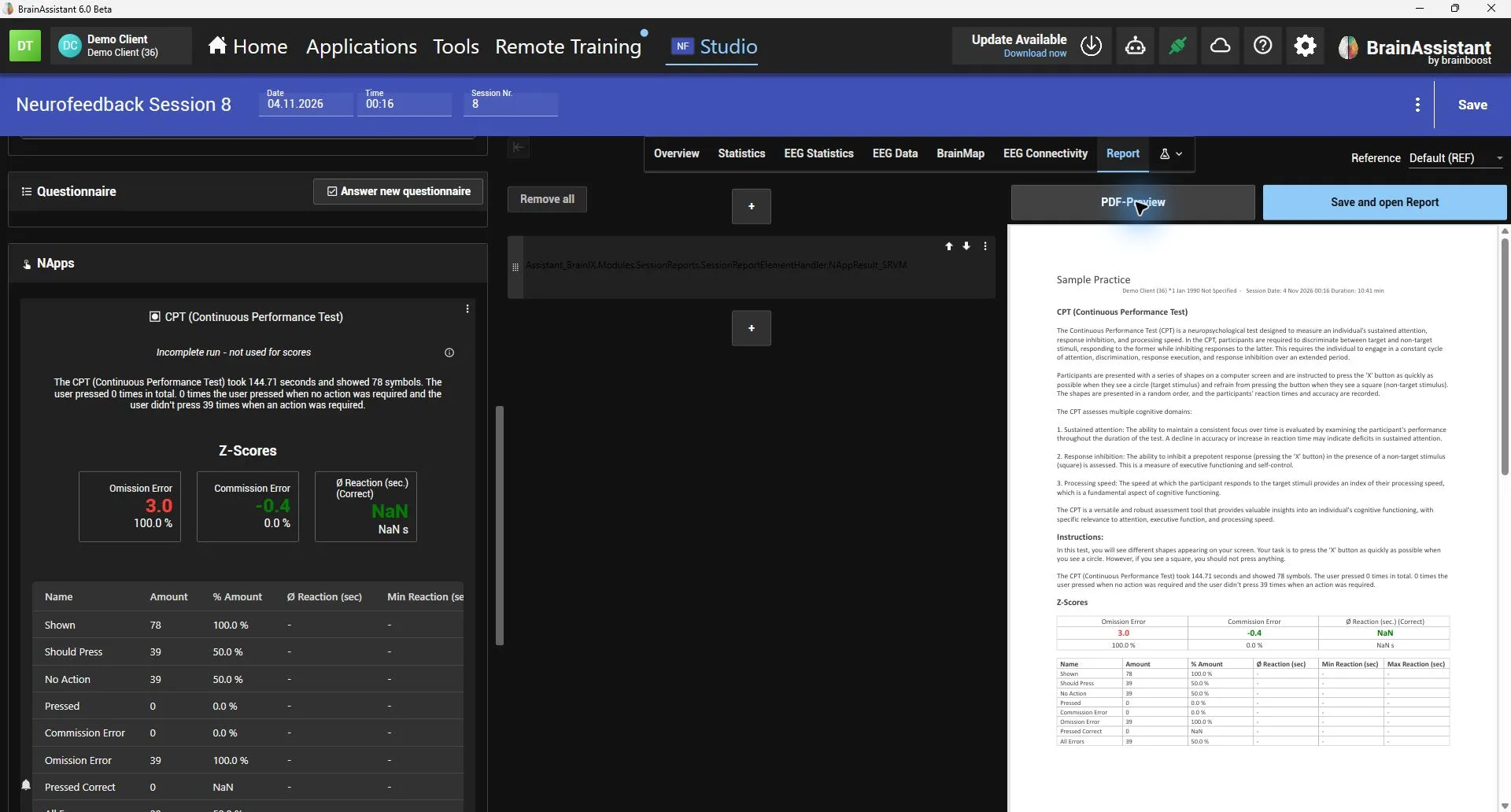
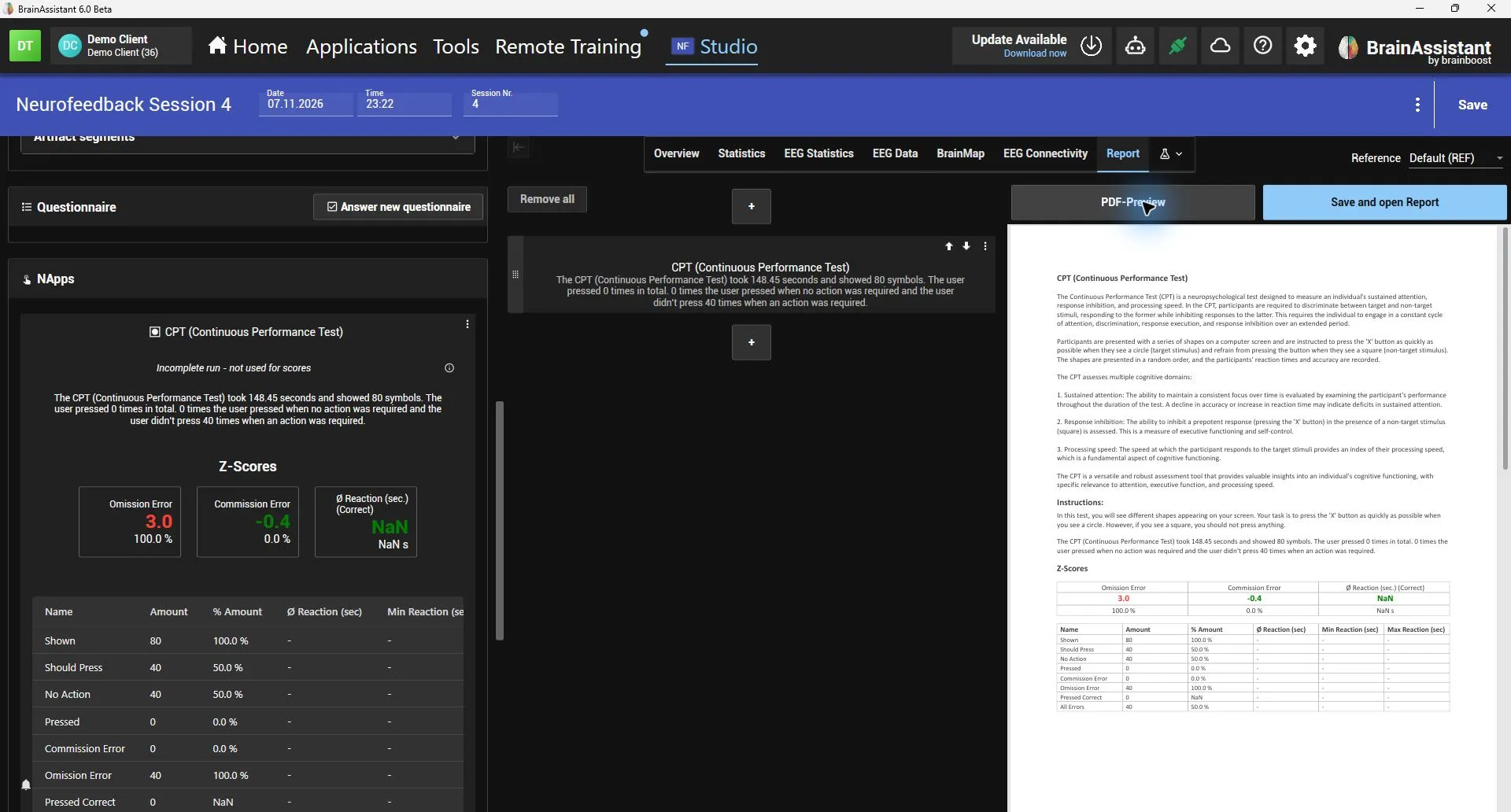
Every run is stored with the session. The result view shows a description, z-scores against reference values and a result table (per stimulus type for Stroop; shown, pressed, correct, omission and commission errors for the CPT) with a plot of the reaction times. The session report prints the same tables, and the report scores read the test metrics as arguments (cpt_..., stroop_..., corsi_..., tapp_..., count_...). When a test was run more than once in a session, the further runs are available as numbered arguments (cpt_1_...).
The CPT counts omission errors relative to the target symbols and commission errors relative to the non-target symbols; accidental double presses within 50 ms are ignored, and a press less than 50 ms after a symbol counts as a late reaction to the previous symbol. The Stroop reaction times come from the correct answers only, without answers under 100 ms and without a few extreme outliers (at most 3 % of the answers). Runs that did not complete (aborted early, no controller input, the 20-second test run) are marked “Incomplete run” in the result view; the report scores, the Research Hub and the brain age estimate use the first complete run of a test.
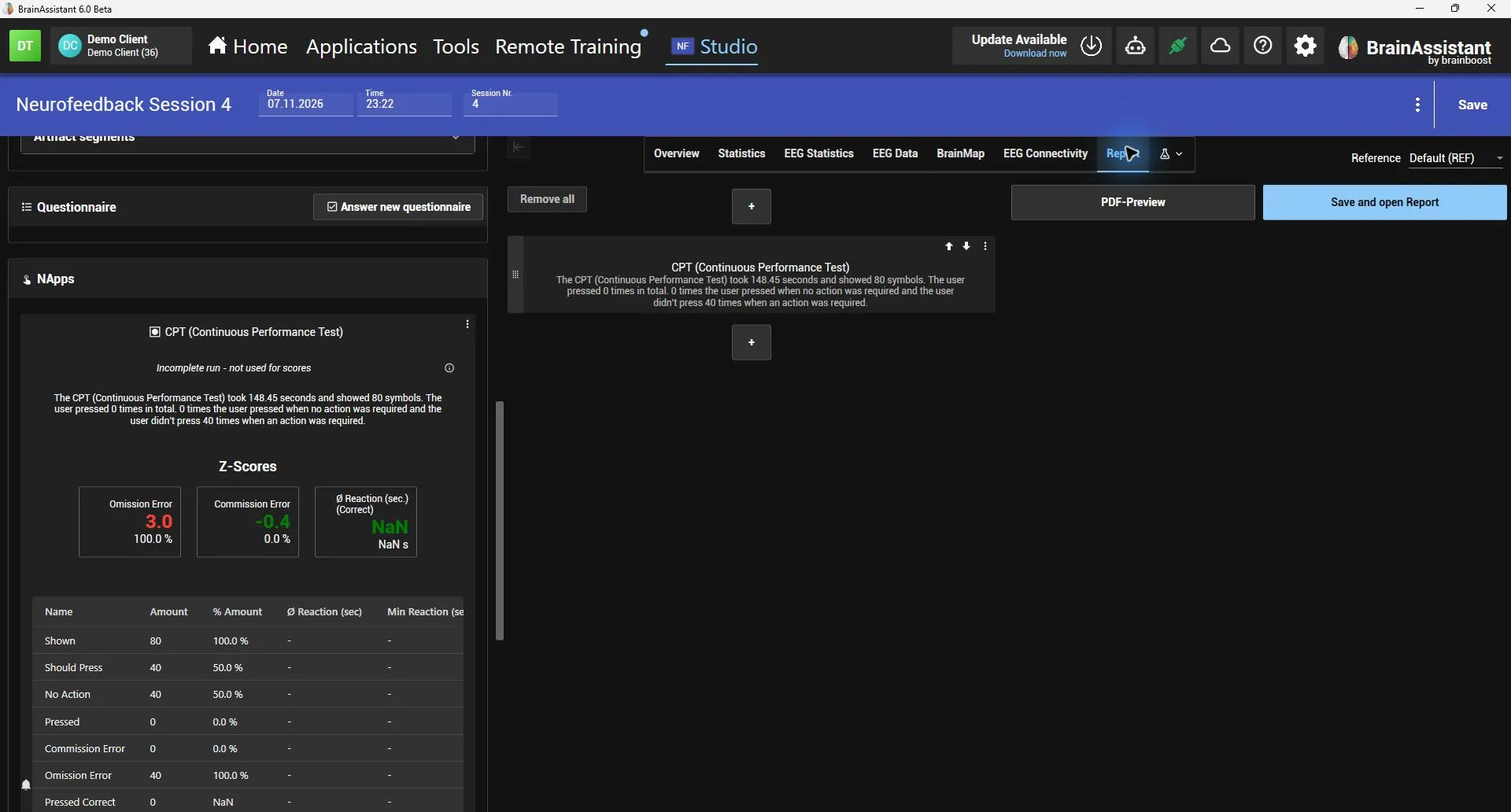
A CPT or other cognitive test result added to a report now shows the test’s name and its result sentence in the report editor instead of an internal label. The PDF is unchanged.
CPT: omission errors are counted relative to the target symbols and commission errors relative to the non-target symbols (previously both relative to all symbols), in the result table, the z-scores and the report scores alike. Accidental double presses within 50 ms are ignored, and a press less than 50 ms after a symbol counts as a late reaction to the previous symbol.
Stroop: the reaction times come from the correct answers only; answers under 100 ms and a few extreme outliers (at most 3 % of the answers) are left out.
Incomplete or aborted runs, including the 20-second test run, are marked “Incomplete run” in the result view and skipped: the report scores, the Research Hub and the brain age estimate use the first complete run of a test. Further runs stay available as numbered arguments (cpt_1_..., stroop_1_...).
The CPT and Stroop result views explain these calculation rules in a feature-info badge (the info icon at the top right of the results).
Brain age: the cognitive sub-model was trained on the previous metric definitions and is paused until it is retrained on the new ones; the brain age is EEG-only in the meantime (the “with cognitive tests” line of the element is absent).
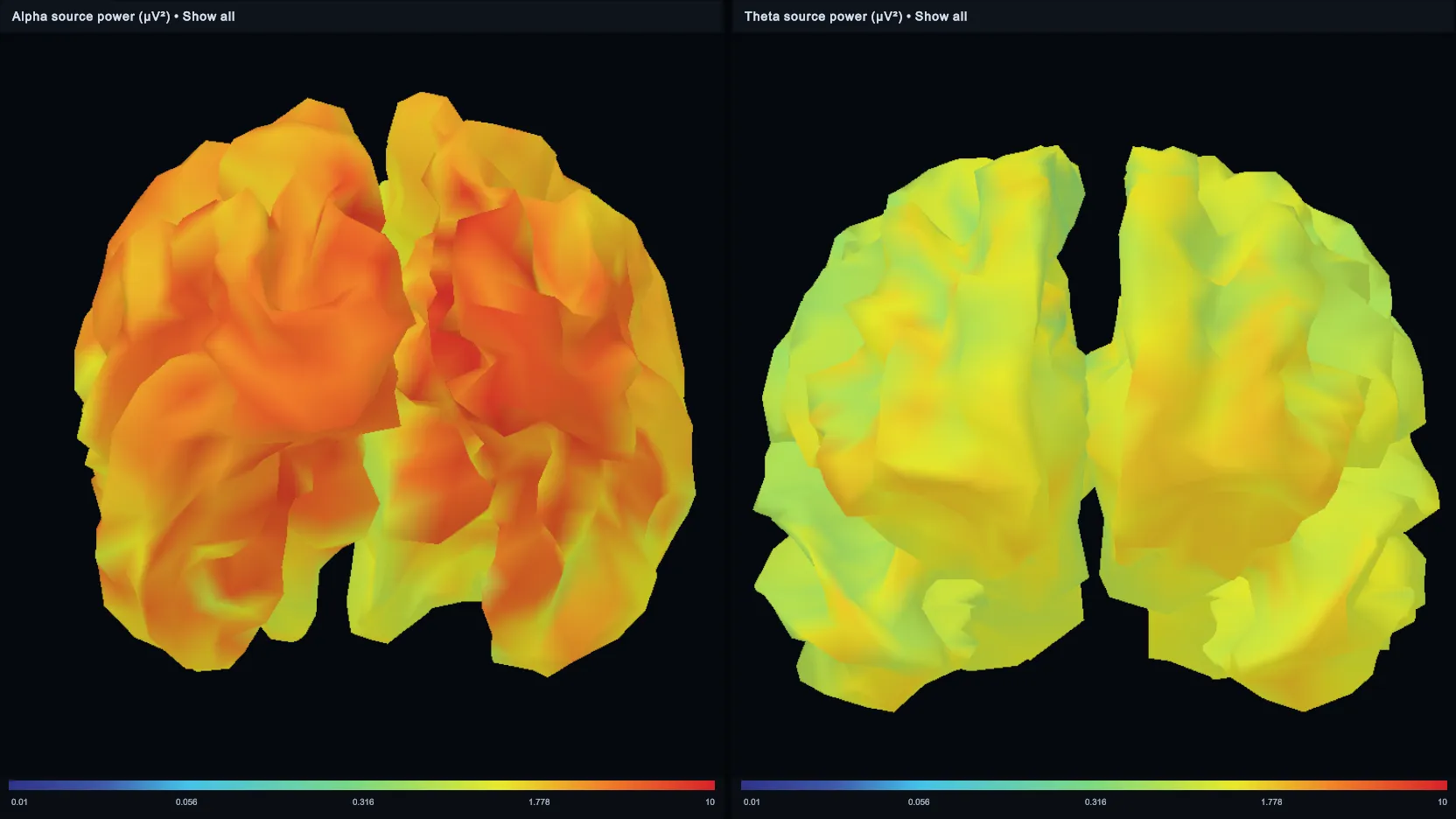
Live or recorded EEG on up to nine animated 3D brains, in live sessions and in the Studio, with presets, EEG position and connectivity layers and a report element.